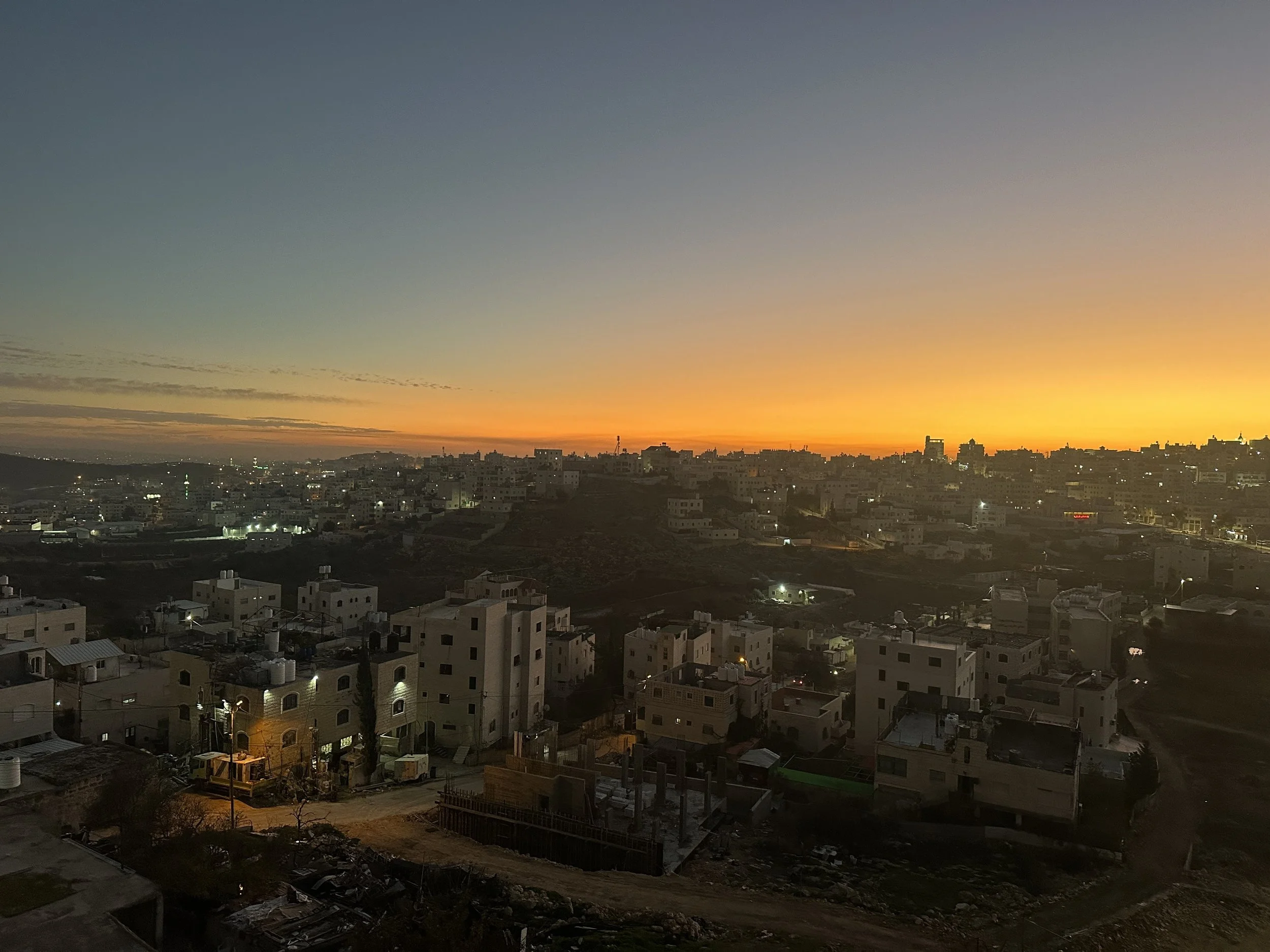
Located some 35km south of Jerusalem, Hebron is the second largest city in the West Bank after East Jerusalem with around 215,000 Palestinian inhabitants. A city full of history and tradition, it is believed to be the burial site of Abraham and is therefore holy to Muslims, Christians and Jews. The city is located along the largest mountain chain in Palestine. The city's mountainous landscape varies from heights of 300m in western areas to 1000m in the center of Hebron governorate. The city is the economic center of the West Bank, and full of social, economic and cultural life, as well as hosting sports and a number of academic institutions.
Hebron's huge potential is severely impacted by the Israeli military occupation of the West Bank, including East Jerusalem, and Gaza. This entails the Israeli government's separation policy in Hebron, its illegal settlement enterprise, and its violations of human rights and international law. Justifying its actions with the pretext of protecting around 500-800 Israeli settlers in the heart of the city, as well as almost 8000 settlers in the nearby Kiryat Arba settlement, the Israeli military has installed a system of separation that has forced thousands of Palestinian inhabitants of the city to leave their homes. The once lively old city of Hebron has turned into a ghost town.
Hebron has long occupied a central place in the political, economic, and social life of Palestine. Archaeological and historical records indicate continuous habitation for thousands of years in the ancient neighborhood of Tel Rumeida, with the city emerging as a regional center during successive periods of Canaanite, Roman, Byzantine, Islamic, Ottoman, and later British rule. Throughout these eras, Hebron developed as a hub for agriculture, trade, religious learning, and craftsmanship, closely linked to its surrounding villages and rural economy. Modern day Hebron remains a hub of industry and business to Palestinians.
During the Ottoman period, Hebron functioned as an important administrative and commercial center in southern Palestine. Its economy was traditionally based on agriculture, stone masonry, leather production, glassmaking, and trade in grapes and other local products. Family networks, religious institutions, and guilds structured much of the city’s social and economic life, while its location along key trade routes connected it to Jerusalem, Gaza, and the coastal plains. Under the British Mandate (1917–1948), Hebron continued to grow demographically and economically, maintaining its role as a major urban center outside Jerusalem.
Following the establishment of Israel 1948, Hebron became part of the Jordanian-administered West Bank. During this period, the city expanded significantly, both in population and infrastructure. Educational institutions were established, municipal services expanded, and Hebron consolidated its position as an economic engine for the southern West Bank. The city’s industries—particularly stone and marble, footwear, and small-scale manufacturing—developed alongside a strong commercial sector that served a wide regional market. Many of the Palestinian refugees who were driven out of their homes by pre-Israeli militia in 1947-1949 eventually settled in Hebron—and some are now facing the threat of a second displacement.
The Israeli occupation of the West Bank in 1967 marked a profound turning point in Hebron’s history. Like other Palestinian cities, Hebron was subjected to military rule, land expropriation, and restrictions on political life. However, Hebron is facing a unique form of occupation due to the establishment of Israeli settlements inside the city center. In 1968, a group of Israeli settlement pioneers led by Moshe Levinger rented a Palestinian hotel for Passover. Yet the group refused to leave and squatted the hotel, demanding the right to establish Israeli settlements. The settlement of Kiryat Arba was then founded on Palestinian land on the outskirts of the city, followed by smaller settlement enclaves inside the Old City itself where caravans arrived on Palestinian land, which fundamentally altered the urban and social landscape.
These changes intensified after 1994, following a massacre committed by American-Israeli settler Baruch Goldstein who killed 29 people in the historic Ibrahimi Mosque. This tragedy was followed by the signing of the Hebron Protocol. Under this agreement, the city was divided into two administrative zones: one under limited Palestinian civil control (H1) and another, encompassing the Old City and areas where Israeli settlers reside, under full Israeli military control (H2). This division formalized a fragmented governance structure within a densely populated urban environment and entrenched a system of movement restrictions, military presence, and differential legal treatment for residents.
Since that time, Hebron has experienced increasing spatial and social fragmentation due to the Israeli occupation and settlement project. The closure of streets, imposition of checkpoints, and declaration of restricted areas have had far-reaching consequences for the city’s economy and social cohesion. The Old City, once a commercial and cultural center, has been particularly affected, with many businesses forced to close and residents displaced due to access restrictions and deteriorating living conditions. At the same time, Hebron’s wider urban area has continued to grow, reflecting both demographic pressures and the city’s enduring role as a regional center.
Today, Hebron exemplifies the intersection of deep historical continuity and ongoing political disruption. Its development has been shaped by centuries of social and economic activity, while its present reality is defined by policies and structures imposed since 1967, and particularly since 1994. Understanding Hebron requires recognizing both its historical significance and its contemporary conditions.